Compare Power Stations Side by Side
Select any two portable power stations to compare specs, value metrics, and verdicts. The comparison highlights winners for each category so you can make a confident decision.
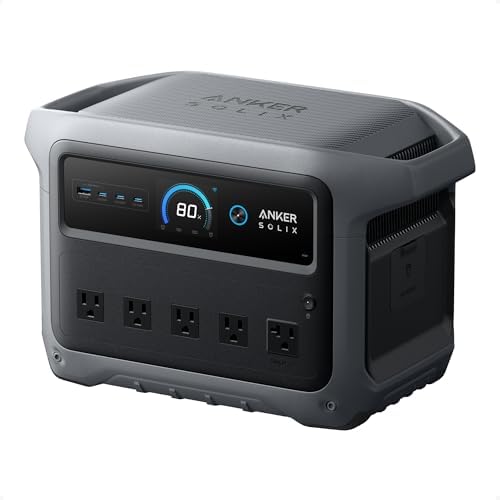

Spec Comparison
| Spec | Anker SOLIX C1000 Gen 2 | EcoFlow Delta 2 | Winner |
|---|---|---|---|
| Capacity | 1,024 Wh | 1,024 Wh | Tie |
| Output | 2,000W | 1,800W | ← |
| Peak Output | 3,000W | 2,700W | ← |
| Weight | 27 lbs | 27 lbs | Tie |
| Charge Time | 49 min to full | 50 min to 80% | — |
| Ports | 10 | 15 | → |
| Battery | LiFePO4 | LiFePO4 | — |
| Price | $430–$799 | $450–$650 | ← |
| Score | 9.2/10 | 8.5/10 | ← |
Value Metrics
| Metric | Anker SOLIX C1000 Gen 2 | EcoFlow Delta 2 | Winner |
|---|---|---|---|
| Wh per Dollar | 1.7 Wh/$ | 1.9 Wh/$ | → |
| Wh per Pound | 37.9 Wh/lb | 37.9 Wh/lb | Tie |
| Output per Dollar | 3.34 W/$ | 3.28 W/$ | ← |
Verdicts
Anker SOLIX C1000 Gen 2
Best overall power station for most people. 1,024Wh with 2,000W output, 49-minute full charge, and 4,000-cycle battery life. The one to beat.
Pros
- + 49-minute full charge — fastest in class
- + 2,000W output (3,000W peak) handles heavy appliances
- + 4,000 battery cycles — lasts 10+ years
- + 10 output ports including 100W USB-C
Cons
- - 27 lbs — not ultraportable
- - App required for some advanced features
EcoFlow Delta 2
Best expandable mid-range option. Start at 1,024Wh, grow to 3kWh with extra batteries. 15 ports covers every device.
Pros
- + Expandable to 3kWh with extra batteries
- + 15 output ports — most in class
- + 50 min to 80% fast charge
- + Wi-Fi app control with firmware updates
Cons
- - 27 lbs at base — heavier with expansion batteries
- - Expansion batteries sold separately ($200–$400)
Most Popular Comparisons
- Anker SOLIX C1000 Gen 2 vs EcoFlow Delta 2 — The two best mid-range options with 1,024Wh capacity. Anker wins on output (2,000W vs 1,800W), EcoFlow wins on expandability and ports.
- Jackery Explorer 1000 v2 vs Anker SOLIX C1000 Gen 2 — Jackery is lighter at 23.8 lbs vs 27 lbs, but Anker delivers more power (2,000W) and charges faster (49 min).
- EcoFlow Delta Pro 3 vs Jackery Explorer 5000 Plus — The whole-home showdown. EcoFlow has 4,000W output and 240V, Jackery has the highest capacity at 5,040Wh out of the box.
- Bluetti AC180 vs Jackery Explorer 1000 v2 — The value play. Bluetti delivers 1,152Wh for under $500, while Jackery is lighter with better brand recognition at a higher price.
How to Choose Between Two Power Stations
Picking the right power station comes down to three tradeoffs: capacity vs. portability, output vs. price, and features vs. simplicity.
Capacity vs. Portability: More watt-hours means longer runtime, but also more weight. If you carry your power station to a campsite, prioritize Wh-per-pound. A unit that delivers 40+ Wh/lb is excellent. If your station stays in one place (RV, garage, home backup), prioritize raw capacity instead.
Output vs. Price: Higher continuous wattage lets you run bigger appliances (hair dryers, microwaves, power tools). But you pay for it. Check the output-per-dollar metric above. If you only need to charge phones and laptops, a 300W compact unit saves hundreds of dollars over a 2,000W mid-range.
Features vs. Simplicity: Expandable batteries, app control, and 240V output add flexibility but also complexity and cost. If you want a plug-and-play experience, a self-contained unit from Jackery or Anker keeps things simple. If you want a modular system that grows with your needs, EcoFlow and Anker's expandable lines give you that option.
Not sure what size you need?
Use our sizing calculator to add up your devices and get a personalized recommendation.
Use Our Sizing Calculator →